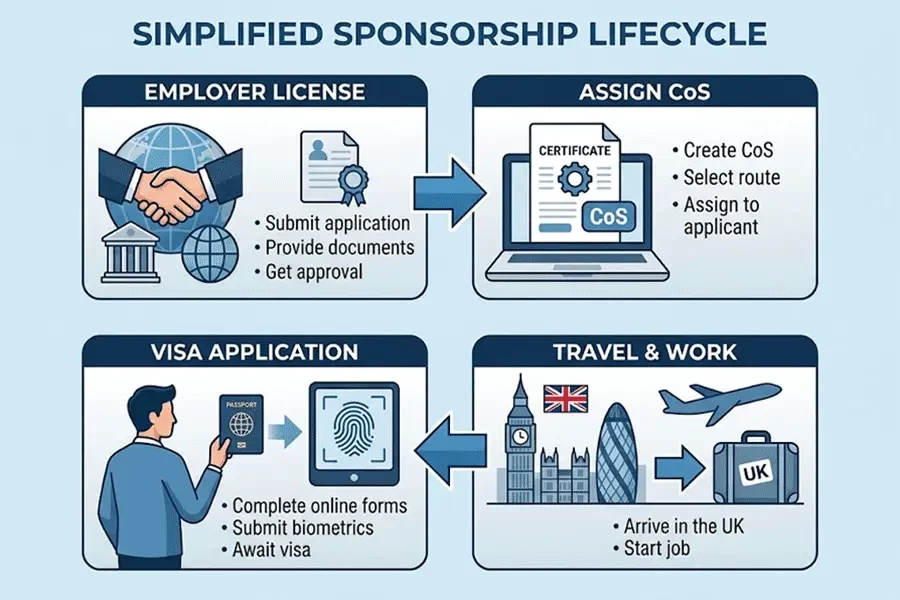
'Do you offer sponsorship?' is the most common question we see from candidates, and the answer most people get is either wrong or three years out of date.
The rules changed substantially in July 2025 and again in January 2026. Most jobs advertised in the UK cannot be sponsored at all, and no employer can legally charge you for the privilege.
What sponsorship means
Sponsorship is not something an employer does as a favour, it is a licence.
To sponsor anyone, a UK employer must hold a sponsor licence issued by the Home Office. Licences cost £611 for small businesses and charities, or £1,682 for medium and large organisations, and take around eight weeks to obtain.
If a company does not hold a licence, it cannot sponsor you.
If the employer does hold a licence, it can assign you a Certificate of Sponsorship, which is electronic and not a physical document. You must apply within three months of getting it.
The four things you need
For the main work route, the Skilled Worker visa, all four must be true:
- A job offer from an employer holding a valid sponsor licence
- A job on the eligible occupations list at the right skill level
- A salary that meets the threshold for that occupation
- English at level B2
As of August 2026
You must be paid whichever is higher £41,700 a year, or the published 'going rate' for your occupation code.
Some applicants qualify on a reduced threshold of £33,400. That covers people under 26, current or recent UK students and Graduate visa holders, those training towards a regulated profession, holders of a relevant STEM PhD, postdoctoral researchers, and jobs on the Immigration Salary List. A relevant non-STEM PhD gets you a smaller discount, with a floor of £37,500.
Skill level
Since 22 July 2025, the job must generally sit at degree level (RQF 6). Occupations below that are only eligible if they appear on the Immigration Salary List or the Temporary Shortage List.
English
Level B2 on the CEFR scale, raised from B1 on 8 January 2026. You are exempt if you are a national of one of a set of majority English speaking countries, or hold a degree taught in English.
Cost to you
Application fee £819 for up to three years or £1,618 for longer, applying from outside the UK.
From inside the UK it is £943 or £1,865. Jobs on the Immigration Salary List are cheaper. £628 or £1,235.
On top, the immigration health surcharge is usually £1,035 per year, and you must show £1,270 in savings held for 28 consecutive days unless your employer certifies maintenance.
A three year visa from overseas therefore costs roughly £3,900 before flights.
Timings
Usually three weeks for a decision outside the UK, eight weeks inside.
If you work in health or education
Doctors, nurses, midwives, allied health professionals and eligible NHS roles use the Health and Care Worker visa instead, and it is far cheaper £324 for up to three years or £628 for longer, no immigration health surcharge at all, and a salary floor of around £25,000 or the relevant NHS pay scale.
If you are a registered clinician, this is your route.
Do not let anyone put you on the standard Skilled Worker route and charge you an extra £3,000 in surcharge you never owed.
Teachers and some education roles also have going rates set by national pay scales rather than the standard table.
The jobs that cannot be sponsored
Since the July 2025 changes, the overwhelming majority of jobs advertised on any UK job board cannot be sponsored, because they sit below degree level and are not on either shortage list.
That includes most:
- Warehouse, picking, packing and driving roles
- Retail and customer service roles
- Hospitality, kitchen and cleaning roles
- Administrative and call centre roles
- Care worker and senior care worker roles
Overseas recruitment of care workers and senior care workers (occupation codes 6135 and 6136) ended on 22 July 2025.
If you are outside the UK, no care home or agency in Britain can sponsor you, whatever anyone tells you. If you are already in the UK legally, an employer can still sponsor you, but only if you have worked for them for at least three months first, and that transitional route runs to 22 July 2028.
If you are searching for 'jobs with visa sponsorship' and applying to warehouse and care adverts, you are not going to get a visa.
Routes that need no sponsor at all
Graduate visa
If you finished an eligible UK course on a Student visa, you can stay and work in any job.
Two years if you apply on or before 31 December 2026, dropping to 18 months from 1 January 2027. Three years for a PhD.
Fee £937.
Youth Mobility Scheme
Two years in the UK doing almost any work.
Ages 18 to 35 for Australia, Canada, New Zealand and South Korea.
Ages 18 to 30 for Andorra, Iceland, Japan, Monaco, San Marino and Uruguay. Hong Kong and Taiwan nationals must be selected in a ballot.
Fee £340. You need £2,530 in savings.
High Potential Individual
For graduates of eligible non-UK universities in the last five years. Two years, or three with a PhD. No job offer needed.
£880 plus £252 for qualification verification.
Global Talent
For leaders or potential leaders in academia, research, arts, culture or digital technology. Requires endorsement rather than an employer.
Fee £766.
UK Ancestry
If you have a grandparent born in the UK and you are a Commonwealth citizen.
India Young Professionals Scheme and the British National (Overseas) route also require no sponsor.
How to check an employer can actually sponsor you
Do this before you apply, not after you have paid anyone anything.
The Home Office publishes the register of licensed sponsors on gov.uk. It is a free, public, downloadable list of every organisation permitted to sponsor workers.
Check two things:
- Is the company on it at all. If not, they cannot sponsor you.
- What route are they licensed for. A licence for one route does not cover another.
Agencies often trade under one name and hold the licence under another, or under no name at all because they hold no licence. If someone cannot tell you the exact registered name their licence is held under, treat that as your answer.
Sponsorship scams, and what is actually illegal
People have paid £17,000 and more for Certificates of Sponsorship.
Know what the law says, because it is clearer than most people realise.
Your employer must pay, and cannot recover from you
- The sponsor licence fee and associated admin costs
- The Certificate of Sponsorship fee, for certificates assigned on or after 31 December 2024
- The Immigration Skills Charge
Since 9 April 2025, a sponsor that recoups or even attempts to recoup any of these from a worker will normally have its licence revoked.
You can lawfully be asked to pay your own visa application fee, your immigration health surcharge, and your own legal costs if you chose to instruct someone.
An employer may also ask you to repay some of these if you leave early, provided the arrangement is transparent and does not drag your pay below the salary threshold.
An employment agency cannot charge you a fee for finding you work.
So: if anyone asks you for thousands of pounds for a job, a certificate, or a 'sponsorship slot', they are either committing an offence or about to cost their client its licence.
Where to report it
Contact the Home Office, the Gangmasters and Labour Abuse Authority, or the Modern Slavery and Exploitation Helpline on 08000 121 700.
You do not need to be certain, and reporting does not require you to give up your own status.
If your sponsor loses its licence
If your employer's licence is revoked, you normally have 60 days to find a new sponsor, apply for a different visa, or leave.
Two practical things. Keep your own copies of your CoS reference, contract and payslips somewhere that is not your work email. And if you are in this position, you are more employable than you think. You are already in the UK, already trained, and already have a track record a new sponsor can verify.
Frequently asked questions
Can I get a UK visa without a job offer?
Yes, on several routes. The Graduate, Youth Mobility Scheme, High Potential Individual, Global Talent, UK Ancestry and British National (Overseas) routes all allow you to work without an employer sponsoring you.
How much does a UK Skilled Worker visa cost in 2026?
From outside the UK, £819 for up to three years or £1,618 for longer, plus the immigration health surcharge of around £1,035 per year, plus proof of £1,270 in savings. Roughly £3,900 for a three-year visa.
What is the minimum salary for a Skilled Worker visa?
£41,700 a year or the going rate for your occupation, whichever is higher. A reduced threshold of £33,400 applies to some applicants, including those under 26, recent graduates and holders of a relevant STEM PhD.
Can care homes still sponsor care workers?
Not from overseas, that closed on 22 July 2025. UK based workers can still be sponsored by an employer they have worked for for at least three months, until 22 July 2028.
Is it legal for an employer to charge me for sponsorship?
NO, sponsors cannot pass on the licence fee, the Certificate of Sponsorship fee or the Immigration Skills Charge, and doing so normally costs them their licence. Employment agencies cannot charge you to find you work at all.
How do I know if a company is a licensed sponsor?
Search the Home Office register of licensed sponsors on gov.uk, using the employer's exact registered name.
What happens if my sponsor's licence is revoked?
You usually get 60 days to find a new sponsor, switch to another visa, or leave the UK.
Before you apply
If an advert does not say its's offering sponsorship, assume it is not, and ask before you invest anything in applying.
Figures and rules checked against GOV.UK in August 2026. Immigration rules change frequently and often at short notice. Always confirm current requirements on gov.uk before applying or paying anything. This is general information, not immigration advice. For advice on your own circumstances, use an adviser regulated by the Immigration Advice Authority.