Every carer who applies to you has already been approached by someone else.
In Birmingham there are around 300 CQC registered home care agencies, three national care groups running 13 homes inside the city boundary, four NHS trusts hiring continuously, and three supermarkets paying more than the care sector average for shelf work.
This is your competition, what they pay, and where each of them is weak.
Most providers think their competition is the home down the road. It isn't, your competition is every employer within one bus ride that pays by the hour.
They fall into four groups, and each one takes a different type of candidate off you.
1. The national care groups
Before you write your next advert, read the ones already running. The social care jobs in Birmingham live on our board and are the same roles you are trying to fill, in the same postcodes, often at the same rate.
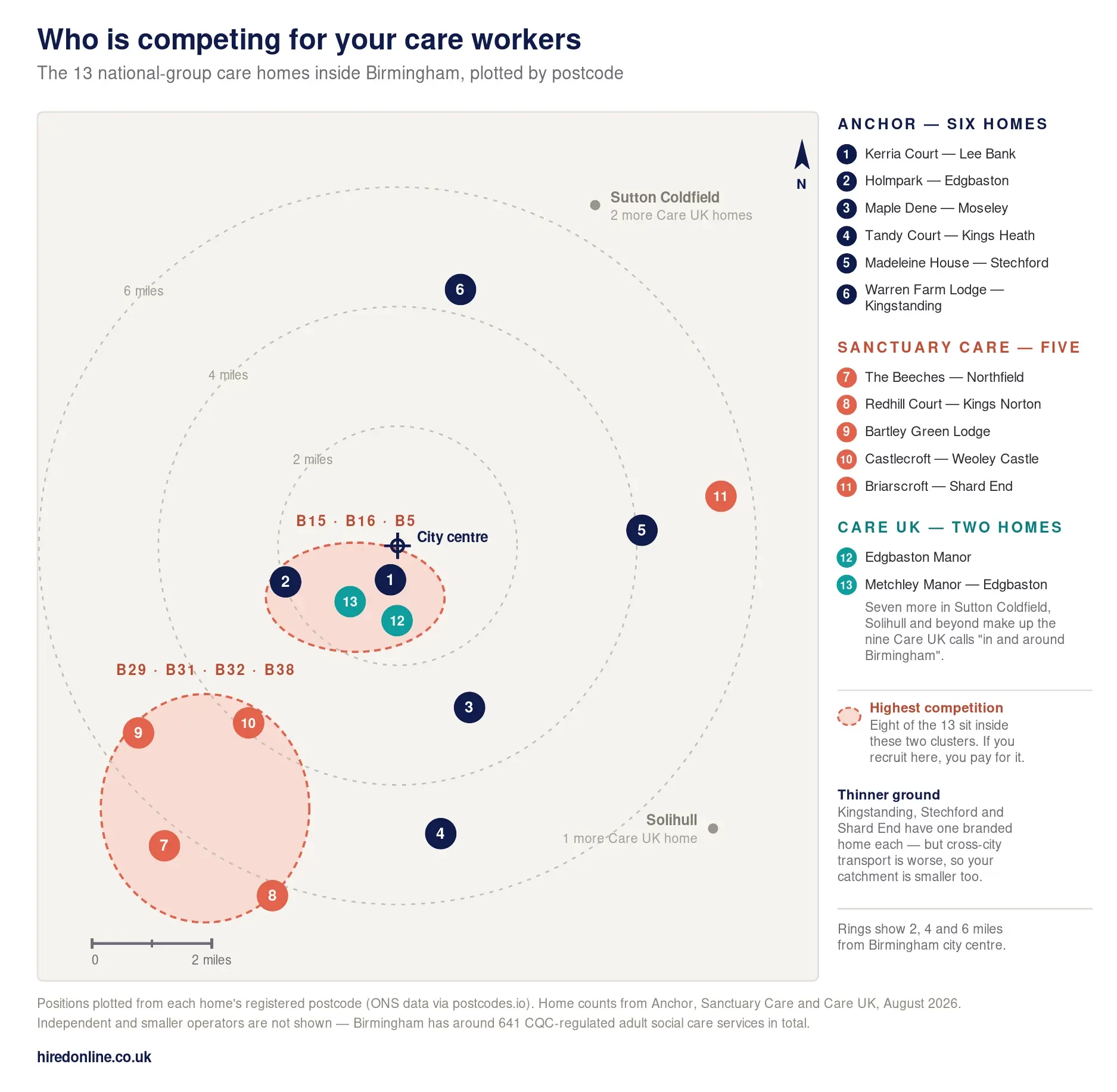
Three operators run 13 homes between them inside Birmingham.
Anchor run six homes
Kerria Court (Lee Bank), Holmpark (Edgbaston), Maple Dene (Moseley), Tandy Court (Kings Heath), Madeleine House (Stechford) and Warren Farm Lodge (Kingstanding).
Anchor is an accredited real Living Wage employer. That is the single most important fact in this section. The real Living Wage is £13.45 an hour, and Anchor has publicly committed to it across its estate.
If you are advertising below £13.45 within three miles of an Anchor home, you are the fallback option.
Sanctuary Care run five homes
The Beeches (Northfield), Redhill Court (Kings Norton), Bartley Green Lodge (Bartley Green), Castlecroft (Weoley Castle) and Briarscroft (Shard End). All five are rated Good by the CQC.
Sanctuary is not for profit and part of a group employing 7,300 care colleagues nationally.
They lead with career progression and internal promotion, not with pay.
Care UK run two in the city, nine within reach
Edgbaston Manor and Metchley Manor sit inside Birmingham. Bishops Manor and Mercia Grange in Sutton Coldfield, Blossomfield Grange in Solihull and four more make up the nine that Care UK describes as 'in and around Birmingham'.
A carer in Erdington or Kingstanding can reach Sutton Coldfield. A carer in Hall Green or Acocks Green can reach Solihull.
Where the pressure sits geographically
Map those 13 homes and the clustering is obvious.
Four of them are in or beside Edgbaston. Four more sit in the south-west corner across Northfield, Bartley Green, Weoley Castle and Kings Norton.
If you run a service in B15, B16, B29, B31, B32 or B38, you have the most competition.
Kingstanding, Stechford and Shard End have one branded home each, so there is less pulling candidates away, but the cross city transport is worse and your realistic catchment is smaller.
2. Four NHS trusts
University Hospitals Birmingham employs more than 20,000 people across the Queen Elizabeth, Heartlands, Good Hope and Solihull.
Birmingham and Solihull Mental Health, Birmingham Community Healthcare and Birmingham Women's and Children's add roughly 17,000 more between them on their own published figures.
Here's what they pay a healthcare assistant.
- NHS Band 2 HCA: £12.92 an hour
- NHS Band 3 HCA: £13.17 rising to £14.05
Don't just look at the hourly rate, consider also what comes with it. NHS pension, occupational sick pay from day one, unsocial hours enhancements on nights and weekends, and a visible route to Band 3, then Band 5 nursing.
Where the NHS is weak
- Recruitment takes months
- Application forms are long
- References go back years
A carer who wants to start next Monday cannot start with the NHS next Monday. That is your opening.
3. The 300+ home care agencies
Roughly 300 CQC registered home care agencies operate in Birmingham. For scale on how crowded that market is, when Birmingham City Council tendered its Home Support contract, it received 220 tenders.
The council also sets the fee rates that cap what most of those agencies can pay. That is why so many of them compete on hours and flexibility instead of on money.
What they offer
- Shifts that fit school hours
- Work that starts this week
- No requirement to be in one building for twelve hours
What they mostly do not offer
- Paid travel time between calls
- Guaranteed hours
- Mileage that covers the actual cost of the car
4. The employers you're competing with
- National Living Wage: £12.71
- Lidl: £13.45
- Aldi: £13.50
- Amazon (warehouse operative): from £13.64
A Birmingham care assistant on a typical rate is being paid less than a supermarket colleague who has no DBS check, no personal care, no medication competency, no safeguarding responsibility and no emotional weight at the end of a shift.
Where the candidates come from now sponsorship has closed
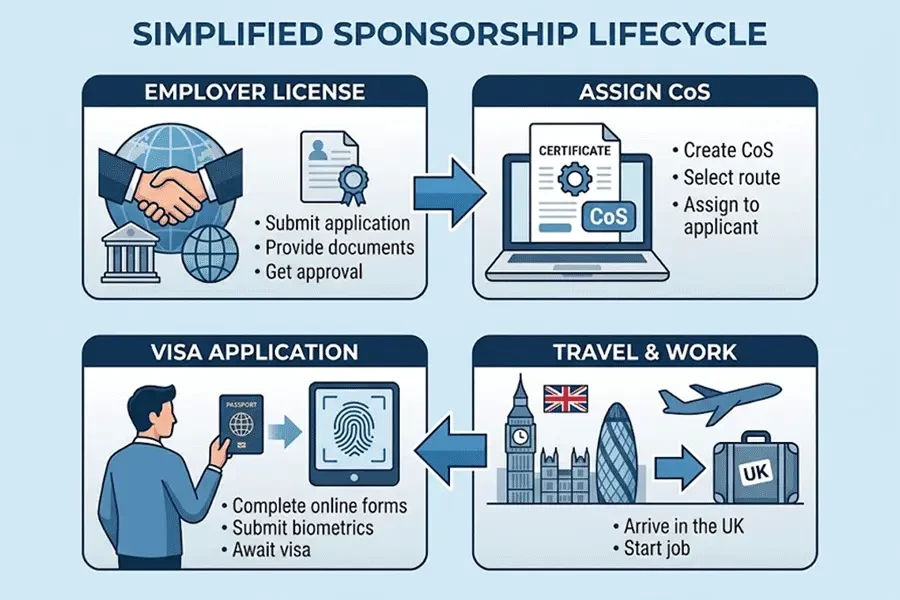
The care worker visa route closed to new overseas applicants on 22 July 2025.
Providers can still assign a Certificate of Sponsorship to someone already in the UK, provided that person has been on the sponsor's payroll for at least three months and is being sponsored in the same SOC code. That route runs until 22 July 2028.
What this means practically in Birmingham
- Your pipeline is domestic, plus people already living here on other visas
- Every advert should state clearly whether you can sponsor or not
- There is a real pool of experienced carers already in the city whose original sponsor has closed or lost its licence, and they are looking
What to actually change in your advert
Against the national groups
Name the postcode and local area, not the city. You will not out brand Anchor, but you can be the home a carer in Kings Heath can walk to.
Against the NHS
Sell speed. Interview this week, start next week, we pay for your DBS, beats a pension a candidate cannot picture.
Against the agencies
Sell certainty, guaranteed hours, one location, fixed rota, paid breaks.
Against the supermarkets
State the actual pay rate. Candidates who see 'competitive' assume you are below Aldi, and usually they are right.
Frequently asked questions
How many care providers are there in Birmingham?
Around 300 CQC registered home care agencies operate in Birmingham, alongside hundreds of registered care homes and supported living services. Birmingham has approximately 641 CQC regulated adult social care services in total and the second largest care workforce of any UK city.
Who are the biggest care employers in Birmingham?
By care home count inside the city, Anchor with six homes, Sanctuary Care with five, and Care UK with two in Birmingham and nine in the surrounding area. By total headcount, the four NHS trusts dwarf them, with University Hospitals Birmingham alone employing more than 20,000 people.
What do care workers get paid in Birmingham in 2026?
The statutory minimum is £12.71 an hour from April 2026. Skills for Care recorded an average Birmingham care worker rate of £11.79 in 2024/25, below the England average. The real Living Wage, which accredited employers such as Anchor pay, is £13.45. NHS Band 2 healthcare assistants earn £12.92.
Can care providers in Birmingham still sponsor overseas care workers?
Not from overseas. The care worker visa route closed to new overseas applicants on 22 July 2025. Providers can still sponsor a worker already in the UK who has been on their payroll for at least three months in the same role code, and that route runs until 22 July 2028.
Which parts of Birmingham are hardest to recruit in?
Edgbaston and the south west corridor covering Northfield, Bartley Green, Weoley Castle and Kings Norton have the highest concentration of national-group care homes, so candidates there have the most choice. North and east Birmingham have fewer branded competitors but weaker cross-city transport, which narrows your realistic catchment.
Advertising against all four
If you are refilling posts at Birmingham's turnover rate, the cost of each hire matters more than the cost of the advert. Our care ads go out to sixteen boards with every applicant AI ranked against your job description.
Advertise a care job in Birmingham or read how to recruit care staff in Birmingham for the workforce data behind these numbers.
Sources: provider home counts from Anchor, Sanctuary Care and Care UK websites, August 2026. NHS pay from NHS Employers Agenda for Change scales 2026/27. Workforce figures from Skills for Care, The state of the adult social care sector and workforce, Birmingham data 2024/25. Home Support tender figure from Birmingham City Council contract award notice. Reviewed annually.